When Care Becomes A Calling
Loyola alumni with mental health careers share how Jesuit and Ignatian values shape their work.
Claire Hoffman Pepose, ’07
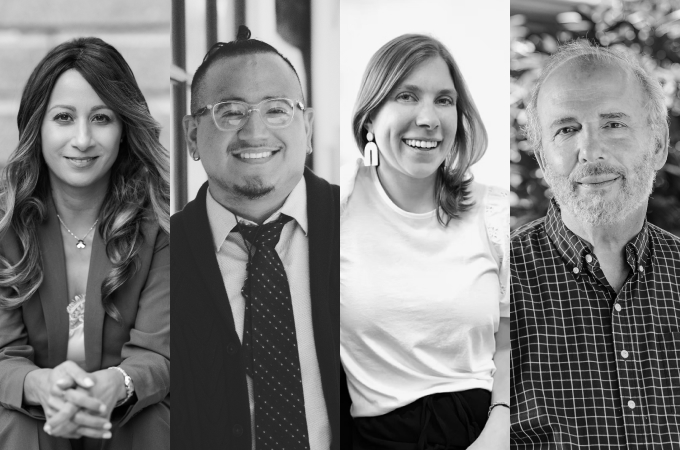 Loyola Alumni Shreya (Patel) Hessler, M.S. ’00, Psy.D. ’03 - Photo by Jennifer McMenamin Photography, Anthony Muentes, ’20, M.S. ’23, Caroline Kovatch, ’21, M.S. ’24, and Carl Robbins, M.S. ’91
For Loyola alumni working in mental health, Jesuit and Ignatian values aren’t abstract ideals. They’re daily practices that shape how care is delivered and relationships are built.
Loyola taught me to see patients as more than a set of symptoms." - Shreya (Patel) Hessler, M.S. ’00, Psy.D. ’03
That philosophy comes through clearly in the work of Shreya (Patel) Hessler, M.S. ’00, Psy.D. ’03, a licensed psychologist and founder and director of The MINDset Center. “I was encouraged to think beyond techniques or diagnoses and focus on what was in the best interest of the person sitting in front of me,” she said of her Loyola education.
Today, cura personalis, or “care for the whole person,” remains central to her work, along with the Ignatian value of reflection. “Loyola taught me to see patients as more than a set of symptoms,” said Hessler. “Taking time to pause, reflect, and examine my choices as a clinician helps me stay grounded, ethical, and present.”
That same whole-person philosophy guides Anthony Muentes, ’20, M.S. ’23, who works as a primary therapist at Compass Health Center in Silver Spring, Maryland. Supporting individuals facing complex mental health challenges, Muentes also emphasizes care that extends beyond symptoms.
“It’s beneficial to care for the entire person,” he said, pointing to the role of physical health, family relationships, and support systems in effective treatment.
He credits Loyola’s emphasis on service and community engagement—and his study abroad experience in Thailand—with shaping how he builds trust with clients from different backgrounds. “Language and other barriers don’t need to stop two people from connecting,” said Muentes, who is proficient in Spanish. “We’re always going to find a way.”
[Play therapy] focuses on the child as a whole person, as opposed to dealing with ‘problem’ behavior." - Caroline Kovatch, ’21, M.S. ’24
For Caroline Kovatch, ’21, M.S. ’24, similar values show up through her work with children and families. Kovatch works as a mental health counselor at Pleasantville Therapy in Pleasantville, New York, where she specializes in child-centered play therapy. Unlike approaches that focus primarily on correcting behavior, she said, “it focuses on the child as a whole person, as opposed to dealing with ‘problem’ behavior.”
She credits Loyola’s clinical training with helping her discover play therapy, and the campus culture with normalizing service to others as part of everyday professional life. “Service opportunities weren’t something you had to seek out. They were just so seamlessly ingrained into campus life,” she remembered.
Loyola produces therapists, rather than technicians.” - Carl Robbins, M.S. ’91
Across generations, Loyola alumni share a belief that the therapeutic relationship sits at the heart of effective care. Carl Robbins, M.S. ’91, a graduate of Loyola’s master’s program in counseling psychology, said that even before evidence-based practice became a dominant framework, Loyola emphasized empathy and presence. Students were exposed to multiple theories and approaches, “but there was never a sense that one was preferred over another”—an approach that encouraged discernment rather than rigid adherence to a single model.
That formation continues to shape how Robbins practices and teaches today as both a senior clinician and the director of training at the Anxiety and Stress Disorders Institute of Maryland. As the field becomes focused on specialization and technique, returning to the relationship remains essential. “Loyola produces therapists, rather than technicians,” he said.