A Community Of Care
A Jesuit approach to well-being drives student success at Loyola
Liam Davis and Jessica Goldstein
One of Cecilia Oliver’s proudest moments as a student leader happened during her outreach work through the student-led group Active Minds.
The senior—who serves this year as the Student Government Association’s director of student support and vice president of the student organization Active Minds— set up a Counseling Center Coffee Hour complete with donuts and a coffee shop music playlist to help students familiarize themselves with the Center. The event was a success—and a strong example of what Oliver calls, “the power that caring can have on the campus community.”
Loyola’s care goes beyond academic success. Loyola wants to see students grow as people and community members." - Cecilia Oliver, ’26
That’s why Oliver loves Loyola so much. “It is very clear that each Loyola employee cares deeply for our students,” she said. “Loyola’s care goes beyond academic success. Loyola wants to see students grow as people and community members.”
A Growing Need
Over the past decade, counseling centers at colleges and universities have seen substantial surge in demand, with nearly three quarters of students reporting moderate or severe psychological distress, according to the American Psychological Association.
At Loyola, student spiritual and mental well-being are the foundation of the University’s broader commitment to student success. This commitment is supported by Loyola’s strategic plan, Together We Rise, which identifies advancing “student and faculty formation” by creating support networks and fostering personal and spiritual growth as one of four focus areas.
Values in Action
To address the call from the strategic plan to better integrate well-being education and support throughout a student’s experience, Jason Parcover, Ph.D., a 25-year leader at Loyola, has stepped into the new role of associate vice president for student well-being. In this position, Parcover works cross divisionally on strategic initiatives that support students’ physical, psychological, and educational development.
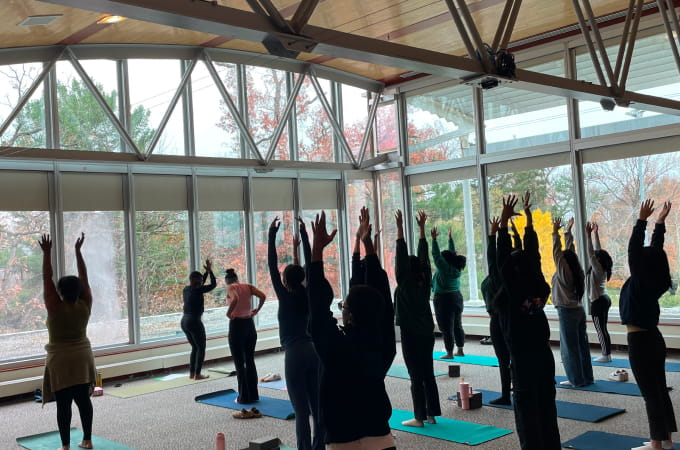 The Counseling Center offers a wide range of health, nutrition, and self-care events, like the Nourish and Rise Wellness Retreat - Photo by Jessica David
“The entire community has embraced the understanding that well-being is central to our mission and is an endeavor that is shared by every division and department,” said Parcover, who oversees the teams in the Counseling Center, Student Health Services, Disability and Accessibility Services (DAS), and Recreation and Wellness.
Loyola’s current approach to well-being stems from a rich history in counseling and pastoral services offered at Loyola. The Counseling Center on campus today was formalized in 1969 by the late Rev. Albert Grau, S.J., Ph.D. In the nearly 60 years since, the Counseling Center has been serving the University community with Jesuit care and compassion.
The entire community has embraced the understanding that well-being is central to our mission and is an endeavor that is shared by every division and department." - Jason Parcover, Ph.D.
The Counseling Center is staffed by experienced professionals who offer in-person and telehealth services to support the mental well-being of Loyola students, as well as emergency support, public health initiatives, and a wide range of health, nutrition, and self-care events.
“At Loyola, our mission calls us to care for the whole person. That happens not just in classrooms, but in conversations, and in the choices we make to uphold a compassionate, welcoming community,” said President Terrence M. Sawyer, J.D. “College can be stressful, and more than a third of students face serious mental health challenges, but they don’t have to face them alone. We have many resources available here at Loyola— and we work to make sure students are aware of where to turn.”
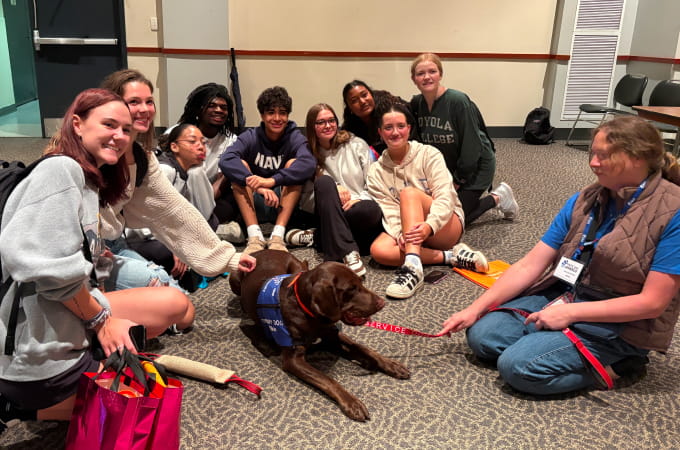
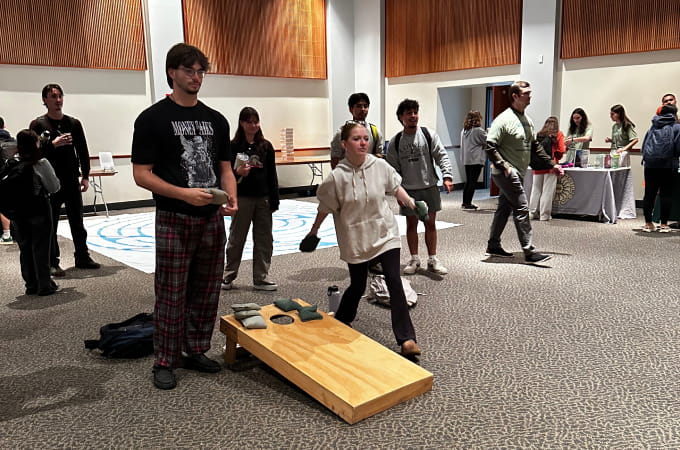 Loyola’s WellFest in the fall promotes wellness resources on campus and also offers a chance to relax with therapy dogs - Photos by Zoe Siminson and Tyler Bean Crooker
Faculty, staff, and students alike are well-versed in the resources available to support students, said Jennifer Stevens, Loyola’s new director of the Counseling Center who has been part of the team for more than 14 years. She referenced that 43% of students seeking Counseling Center services last year reported they were referred by another student or a Loyola professional.
While the Counseling Center is the primary provider of psychological services at Loyola, there are many offices and groups that support well-being and make Loyola a place where students can learn, grow, and thrive.
One example is the University’s new pre-fall program, LENS: Landing at Loyola, a two-day bridge program to help students who identify as neurodiverse adjust to college. The program, which is hosted by DAS, helps ensure students are set up for success with tailored sessions on academic and career resources, and time to develop social connections at Loyola.
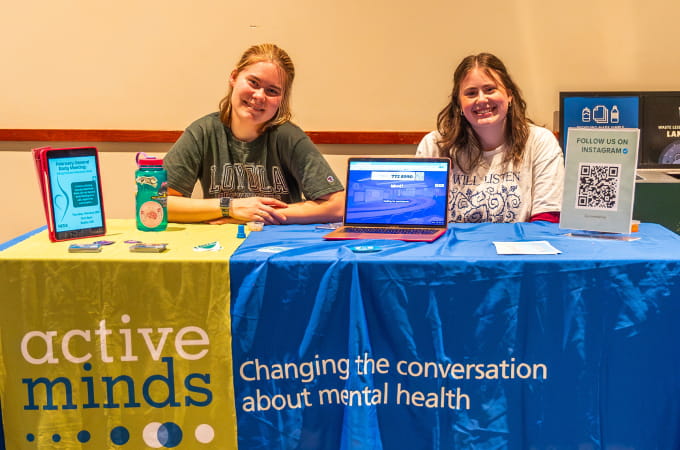 Loyola has an active chapter of Active Minds, a student-run organization working to utilize student voice to change the conversation about mental health on college campuses. - Photo by Aaron Boutwell
The University is also equipping members of the community beyond the Counseling Center. This year alone, Loyola has trained hundreds of students and employees in mental health first aid.
Peer-to-Peer Connection
Student-led organizations on campus also play a vital role in elevating student well-being.
This year, Loyola has formed the Greyhound Wellbeing Network, a new group of students training as peer well-being ambassadors. Also new is Loyola’s Student Wellbeing Action Group (SWAG), which has evolved from a mental health focus to incorporating a broader mission of promoting well-being.
Loyola rounds out its peer-to-peer offerings through Morgan’s Message, geared toward strengthening student-athlete mental health; Togetherall, a 24/7 online platform; and even honors societies’ wellness programming—just to name a quick few.
Go Green for Support
Mental health and well-being best occur in the context of community." - Deborah Cady Melzer, Ph.D.
Then there is the Green Bandana Brigade, which Parcover considers to be one of the University’s most innovative endeavors. The voluntary training program equips community members with the skills to identify signs of distress, offer meaningful support, and connect students to the appropriate resources they may need.
“Upon completing the training, individuals receive a green bandana in Loyola’s signature color—which they can wear on their backpack or display in their office—serving as a powerful symbol of our community’s unwavering commitment to one another’s well-being,” explained Parcover.
People for People
The Counseling Center, the many student-led groups, and other offices on Loyola’s campus— such as Campus Ministry, the Women’s Center, Thrive Center for Student Success, and Student Development—are available to support students, families, and the Loyola community during challenging times.
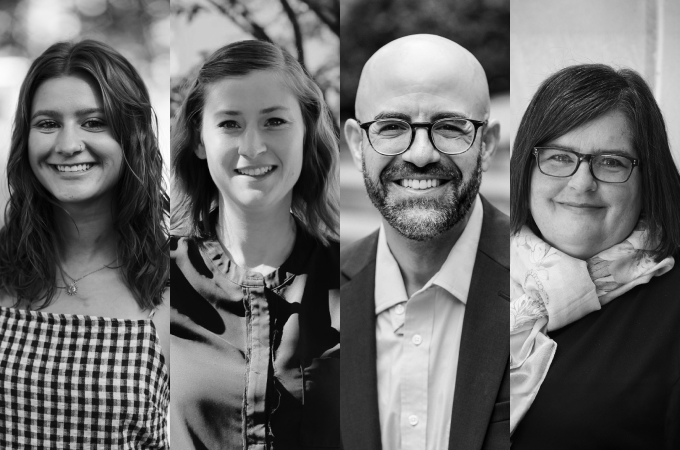 Cecilia Oliver, ’26 - Photo by Aidan Medina, Jennifer Stevens, Jason Parcover, Ph.D., and Deborah Cady Melzer, Ph.D.
“Mental health and well-being best occur in the context of community,” shared Vice President for Student Development Deborah Cady Melzer, Ph.D. “As companions to students, we must create communities of care where we listen deeply to students’ dreams, fears, desires, and disappointments and help them grow emotionally, academically, and spiritually.”
That rings true for Oliver as she tries to make the most of her time on campus before the Global Studies major with minors in environmental studies and writing graduates.
“These experiences have taught me that it is great to aim high, but that it’s also OK to ask for support,” said Oliver. “This is a lesson I will bring with me when I leave Loyola.”
Counseling Center by the Numbers:
Serves about 800 students yearly
Utilized by roughly 45% of students
Contributed to the academic success of 626 students last school year
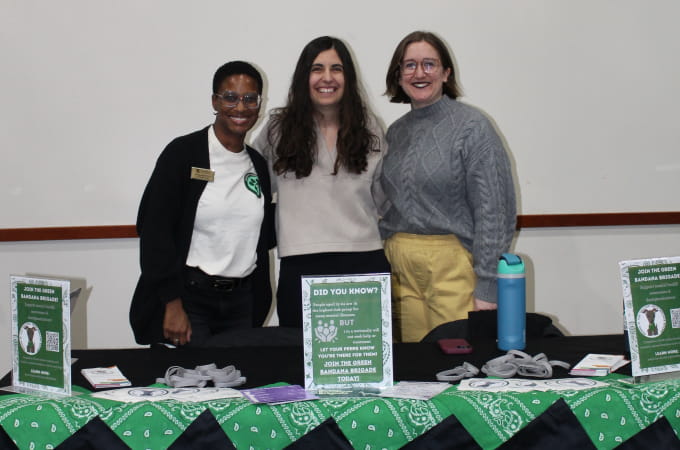 Photo by Claire Perkins, ’23