Rodney Parker, Gina Magyar-Russell, Ph.D.
An Analysis of Neuroticism and Connectedness as Predictors of Sexual Attitudes and Religious Coping
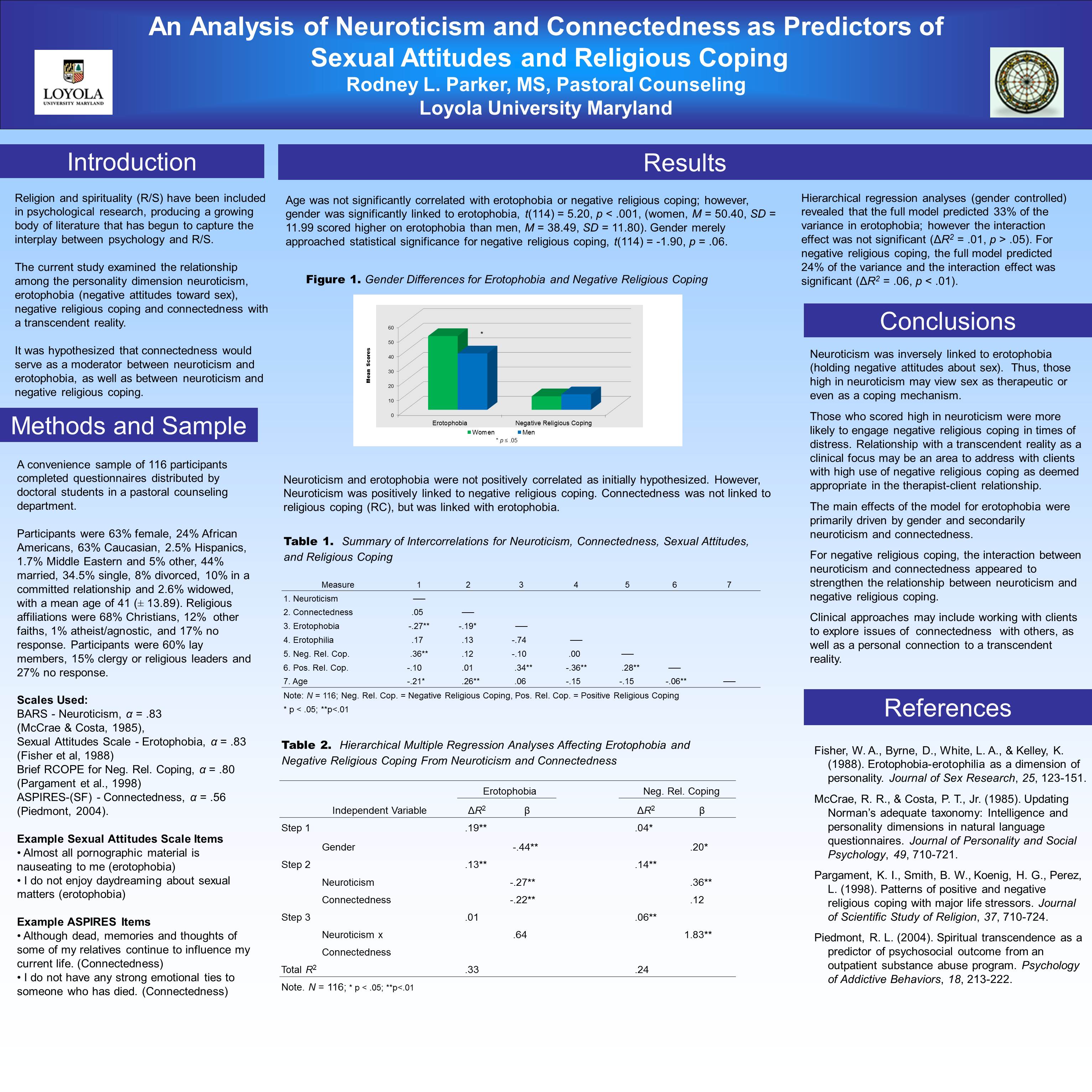
Over the past few decades, religion and spirituality (R/S) have been included in psychological research, producing a growing body of literature that has begun to capture the interplay between psychology and R/S (Abu-Raiya, Pargament, & Mahoney, 2011; Khan, & Watson, 2006; Labbe & Fobes, 2010; Pargament, Smith, Koenig, & Perez, 1998; Piedmont, 1999; Piedmont, Ciarrochi, Dy-Liacco, & Williams, 2009). The current study examined the relationship among the personality dimension neuroticism, erotophobia (negative attitudes toward sex), negative religious coping and connectedness with a transcendent reality. It was hypothesized that Connectedness would serve as a moderator between neuroticism and erotophobia, as well as between neuroticism and negative religious coping.
Method: A convenience sample of 116 participants completed questionnaires distributed by doctoral students in a pastoral counseling department. Variables of interest were measured using the Bipolar Adjective Rating Scales (BARS), Sexual Attitudes Scale, the Brief RCOPE, and Assessment of Spirituality and Religious Sentiments (ASPIRES) Scale – Short Form.
Results: Neuroticism and erotophobia were not positively correlated as initially hypothesized. Hierarchical regression analyses (gender controlled) revealed that the full model predicted 33% of the variance in erotophobia; however the interaction effect was not significant (ΔR2 = .01, p > .05). For negative religious coping, the full model predicted 24% of the variance and the interaction effect was significant (ΔR2 = .06, p < .01).
Conclusion: Connectedness may be an important clinical area to address with clients who have high levels of erotophobia. Treatment may include working with clients on connections they have with others and a transcendent reality, as deemed appropriate in the therapist-client relationship.
Quick Details
April 17, 2026
6 - 8 p.m.
Andrew White Student Center, 3rd Floor Space