Chun-Shin Taylor, Kari A. O'Grady, Ph.D.
Learned Lessons: Resilience Process of Asian Women Married to White Men following the Relational Trauma of Infidelity
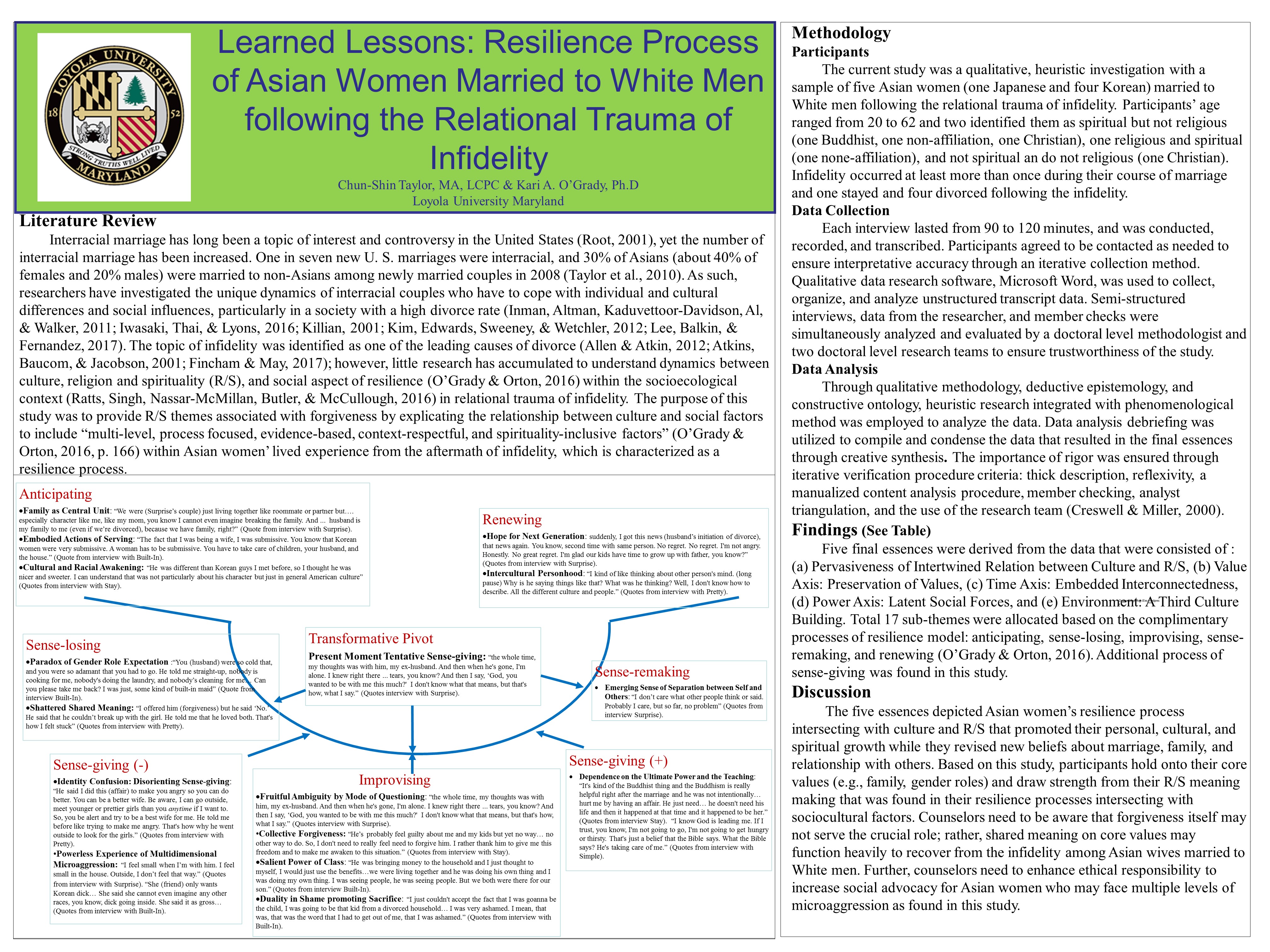
Interracial marriage has long been a topic of interest and controversy in the United
States (Root, 2001), yet the number of interracial marriage has been increased. One
in seven new U. S. marriages were interracial, and 30% of Asians (about 40% of females
and 20% males) were married to non-Asians among newly married couples in 2008 (Taylor
et al., 2010). As such, researchers have investigated the unique dynamics of interracial
couples who have to cope with individual and cultural differences and social influences,
particularly in a society with a high divorce rate (Inman, Altman, Kaduvettoor-Davidson,
Al, & Walker, 2011; Iwasaki, Thai, & Lyons, 2016; Killian, 2001; Kim, Edwards, Sweeney,
& Wetchler, 2012; Lee, Balkin, & Fernandez, 2017).
The topic of infidelity was identified as one of the leading causes of divorce (Allen
& Atkin, 2012; Atkins, Baucom, & Jacobson, 2001; Fincham & May, 2017) and the second
most damaging problem that clients brought to therapy (Whisman, Dixon, & Johnson,
1997). Even though infidelity brings forth detrimental effects on couples, often leading
to divorce (Allen & Atkins, 2012), recovery from infidelity does occur; couples experience
personal and relational growth and healing in the aftermath of the relational trauma
of infidelity (Abrahamson, Hussain, Khan, & Schofield, 2012; Gordon & Baucom, 2003).
Research has been accumulated to propose models for the clinical treatment of infidelity,
in which the roles of forgiveness has identified as a critical step toward recovery
after the infidelity (Abrahamson et al., 2012; Brown, 2001; Glass, 2002; Gordon, Baucom,
& Sndyer, 2005; Olson, Russell, Higgins-Kessler, & Miller, 2002). However, little
research has accumulated to understand dynamics between culture, religion and spirituality
(R/S), and social aspect of resilience (O’Grady & Orton, 2016) within the context
of socioecological context (Ratts, Singh, Nassar-McMillan, Butler, & McCullough, 2016).
Furthermore, there is no study was conducted on the intersection of culture and R/S
with Asian women married to White men following the relational trauma of infidelity.
The current study was a qualitative, heuristic investigation with a sample of five
Asian women married to White men following the relational trauma of infidelity. The
purpose of this study was to provide R/S themes associated with forgiveness by explicating
the relationship between culture and social factors within Asian women’ lived experience
from the aftermath of infidelity, which is characterized as a resilience process to
include “multi-level, process focused, evidence-based, context-respectful, and spirituality-inclusive
factors” (O’Grady & Orton, 2016, p. 166). Five final essences (Pervasiveness of Intertwined
Relation between R/S, Value Axis: Preservation of Values, Time Axis: Embedded Interconnectedness,
Power Axis: Latent Social Forces, and Environment: A Third Culture Building) were
derived from the data and discussed through the literature in the field of counseling
and pastoral counseling. These five essences depicted these Asian women’s resilience
processes, intersecting with culture and R/S that promoted their personal, cultural,
and spiritual growth while they conceived new beliefs about marriage, family, and
relationships with others. Implications on theory development, recommendations for
clinical and pastoral counseling, and future research were discussed.
Quick Details
April 17, 2026
6 - 8 p.m.
Andrew White Student Center, 3rd Floor Space