Loyola receives $200K in grants to harness AI for scientific research
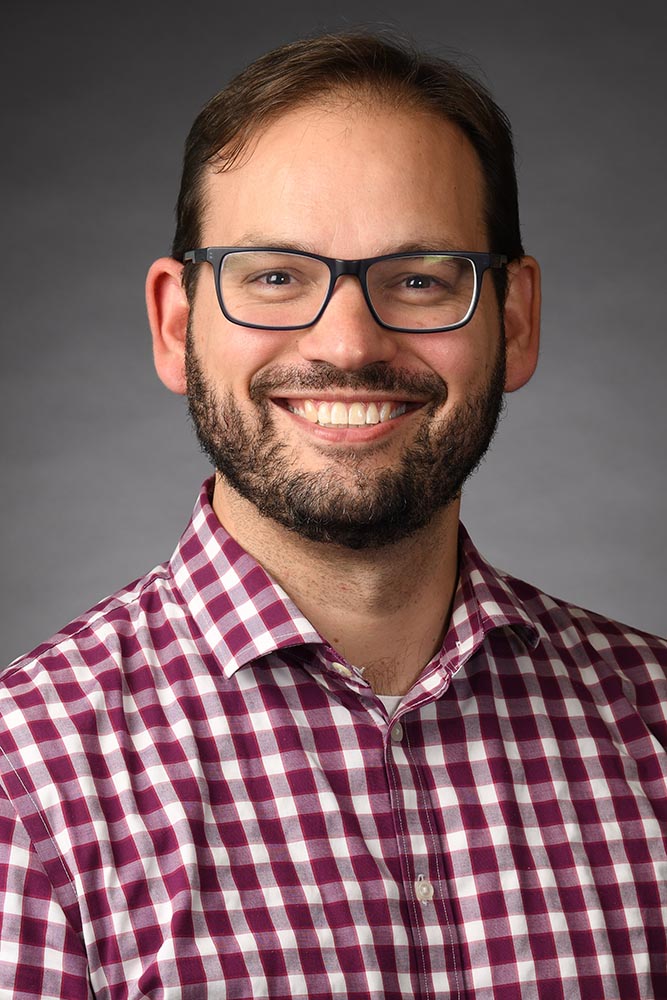
Sibren Isaacman, Ph.D., associate professor of computer science at Loyola University Maryland, received $147,660 in grant funding from the National Science Foundation and $48,243 in grant funding from the U.S. Department of Energy. The grants support two research projects in collaboration with Virginia Tech to harness artificial intelligence for scientific discovery.
The National Science Foundation grant funds a three-year project to build AI models that predict how air pollution forms in the atmosphere. Three undergraduate students will join the project through Loyola’s Hauber Research Fellowship, providing them with hands-on research experience under Isaacman’s mentorship.
“Our undergraduates will be contributing to real machine learning research with real climate science implications and access to resources and people beyond Loyola,” Isaacman said. “It is the kind of experience that can set students on the path to graduate education.”
Isaacman and the research team will examine how thousands of different carbon-containing gases behave as they form air pollutants, such as ozone and aerosols, which are linked to 100,000 deaths and crop losses in the U.S. every year. To accomplish this, Isaacman will build machine-learning models that read chemical data across multiple formats to improve predictions of air pollution formation.
Separately, the Department of Energy grant funds a research project to improve rain forecasts. The project aligns with the Department of Energy’s Genesis Mission, a White House-backed initiative to use AI to increase scientific research. More than 5,000 grant applications were submitted, but only 278 projects received funding.
Isaacman’s project will train AI to examine cloud and precipitation data to determine what factors in the atmosphere contribute to rainfall and improve predictions. The project will take nine months to complete with potential to continue into a larger second phase.
“Dr. Isaacman’s success in securing funding from the NSF and U.S. Department of Energy highlights both his distinction as a teacher-scholar and his leadership in applying artificial intelligence to address challenges in climate science, environmental sustainability, and human health,” said Bahram Roughani, Ph.D., associate dean of the natural and applied sciences. “His dedication to student development is equally evident through support for three Hauber Summer Research Projects, which will provide transformative research opportunities and mentorship for the next generation of scientists.”
For both projects, Isaacman will collaborate with additional researchers including Gabriel Isaacman-VanWertz, Ph.D., professor in civil and environmental engineering at Virginia Tech, and Hoda Eldardiry, Ph.D., associate professor in computer science at Virginia Tech. The work is part of an ongoing research partnership between Loyola’s computer science department and Virginia Tech, which gives undergraduate students at Loyola opportunity to conduct graduate-level research.