Loyola awarded approximately $2.22 million in grants to support renewable energy installation and planning on campus
Loyola University Maryland has been awarded $2.22 million in grants from the Maryland Energy Administration (MEA) to fund renewable energy installation and planning on Loyola’s Evergreen campus and at the Loyola-owned property at 5104 York Road.
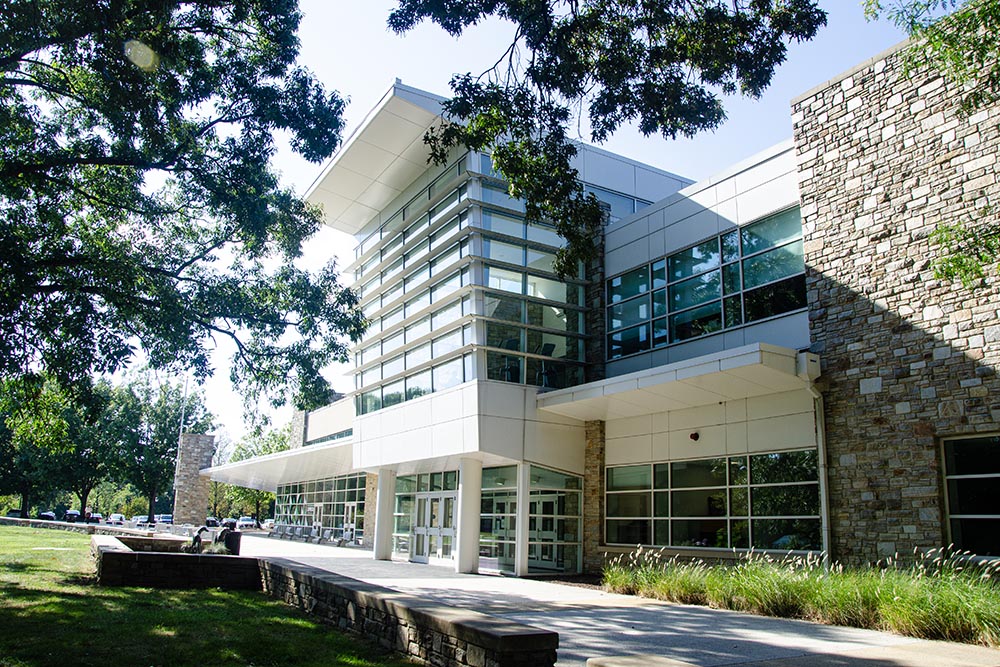
The grants will support the installation of rooftop photovoltaic solar panels on the Fitness & Aquatic Center (FAC) and a solar canopy over the parking lot at 5104 York Road, home to Loyola’s Community Hub and Center for Neighborhood Resilience.
“The introduction of on-campus solar power generation will help Loyola meet its emissions reduction goals outlined in the University’s Climate Action Plan,” said Helen Schneider, associate vice president for facilities and risk management. “We are grateful for the State’s investment in clean energy generation and planning on college and university campuses, especially as we at Loyola focus on living out our Laudato Si’ commitment to care for our common home.”
Loyola received $1.16 million from the MEA’s 2025 Higher Education Clean Energy Grant Program to support solar installation on the FAC, as well as to guide the implementation of the University's Campus Clean Energy Master Plan (CCEMP). The CCEMP identifies key goals and targets for Loyola’s campus based on Maryland’s clean energy goals and defines strategies and options available to achieve these targets. The CCEMP will include four categories of clean energy strategy: 1) on-campus renewable generation, 2) off-campus renewables, 3) energy efficiency projects, and 4) student experience and training.
Loyola received $1.06 million from the MEA’s 2026 Higher Education Clean Energy Grant Program to support solar installation at Loyola’s property at 5104 York Road.
The 2026 grant will also support the development of a new engineering course to be developed by Suzanne Keilson, Ph.D., chair and associate professor of engineering. The course would count as an elective within Loyola’s ABET-accredited B.S. in Engineering, which offers concentrations in mechanical, computer, or electrical engineering. The proposed course will be offered at the 200-level, ensuring no pre-requisites, and will be designed broadly to be accessible to students in related programs of study, such as Environmental Science and Studies, Sustainability Management, and Global Studies.
“We are so grateful for the support from the Maryland Energy Administration that is making these changes possible,” said Kristy Michel, vice president for finance and administration. “This funding will enhance and strengthen the important work that is already underway in the University’s facilities and in the curriculum.”
A student internship bonus included in the grants is funding the hire of Loyola student interns in the University’s Office of Sustainability each semester for three years. The student interns are supporting the development and implementation of the CCEMP and gaining hands-on experience in the clean energy sector.
Dami Sule-Odu, ’28, a data analytics and information systems major, interned during the 2025-26 academic year, and Evan Elmore, ’28, mechanical engineering major, interned during the summer of 2026.
In addition to the solar projects reducing Loyola's emissions and helping advance the University’s Climate Action Plan goals, the projects offer additional benefits such as providing shade (the solar parking canopy at 5104 York Road) and therefore lowering the local urban heat island impact. To learn more about Loyola’s new Climate Action Plan and the University’s work towards Caring for Our Common Home, visit the Office of Sustainability website.
The funds are administered through MEA’s Higher Education Clean Energy Grant Program, aimed at Maryland's Institutions of Higher Education. This competitive, statewide program is designed to foster a holistic approach to sustainability by supporting the adoption of on-site renewable energy technologies, the integration of strategic energy planning into operations and academic curricula, and the advancement of workforce development in the renewable energy sector.