Major in Biology
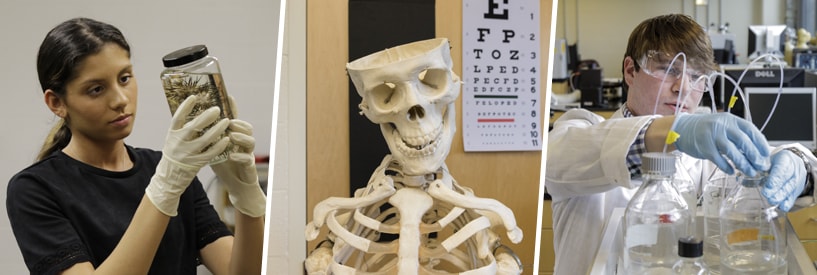
A major in biology requires a minimum of 10 courses in the biology department as well as courses from chemistry, mathematics, and physics. The required courses are as follows:
Biology
- BL 150 - Foundations of Biology I and
- BL 151 - Foundations of Biology I Lab
- BL 152 - Foundations of Biology II and
- BL 153 - Foundations of Biology II Lab
- BL 154 - Foundations of Biology III and
- BL 155 - Foundations of Biology III Lab
- Seven upper-level biology electives (see Elective Restrictions)
Chemistry:
- CH 101 - General Chemistry I and
- CH 105 - General Chemistry Lab I
- CH 102 - General Chemistry II and
- CH 106 - General Chemistry Lab II
- CH 301 - Organic Chemistry I and
- CH 307 - Organic Chemistry Lab I
- CH 302 - Organic Chemistry II and
- CH 308 - Organic Chemistry Lab II
Mathematics:
- MA 251 - Calculus I or
- MA 252 - Calculus II or
- ST 210 - Introduction to Statistics or
- ST 265 - Biostatistics
Physics:
- PH 101 - Introductory Physics I with Lab
- PH 102 - Introductory Physics II with Lab
View the Biology Advising Handbook
View the typical course sequence for a Bachelor of Science in biology.
View all biology course descriptions.
Majors are required to take one advanced course in each of the three major areas of biology: cell and molecular biology, structure and function of organisms, and ecology and evolutionary biology. The upper-level curriculum allows students flexibility to further explore the sub disciplines of biology and generally consist of a classroom component with associated laboratory and/or seminar experiences.
The discipline of biology is experiential in nature, meaning that students are active participants in their own education. The advanced courses include laboratory components in which students learn how to think and write like scientists while designing and executing an experiment. They also learn how to work cooperatively as contributing members of a team and develop a greater sense of academic community.
The general biology curriculum is flexible in the major's requirements for upper-division courses. This flexibility allows students to individualize their curriculum to suit their academic and career goals.
Things to note
- Biology majors should successfully complete BL150/151, BL152/153, and BL154/155 before starting their junior year.
- The math requirement (MA251 or MA252 or ST210 or ST265) may be taken anytime. Most students choose the sophomore or junior years. Students who plan to take General rather than Introductory Physics should arrange to take Calculus I and II during their first or sophomore year.
- Courses from BL100-150, BL152, and BL154 may be elected in partial fulfillment of the natural science core requirement for the non-natural science major.
- For courses numbered 206 and above, if a student decides to withdraw from either the lecture or laboratory component of corequisite courses, then the student must also withdraw from the corresponding lecture or laboratory course. Likewise, if a student fails either the lecture or laboratory component of corequisite courses, both courses must be retaken with passing grades to receive credit within the biology major. A student will not receive credit towards the majors for completing the lecture or laboratory only, either at Loyola or another institution, unless the department chair gives prior written permission.
- To count in the biology major or an associated interdisciplinary major with biology, Human Anatomy and Physiology I (BL 206/BL 207) and Human Anatomy and Physiology II (BL 208/BL 209) must be taken at Loyola or a consortium school.
- Students interested in studying abroad will find many programs available to both biology and interdisciplinary biology majors. Students are encouraged to visit the Office of International Programs early in their careers to plan a course of study for Loyola and the host institution. Students should also consult their academic advisor.
- Honors Program students who complete the functional anatomy course while studying abroad in Glasgow, Scotland or who complete a physiology course while studying abroad in Newcastle, England may not take Introduction to Anatomy and Physiology (BL 105), Human Anatomy and Physiology I (BL 206/BL 207), Human Anatomy and Physiology II (BL 208/BL 209), or Vertebrate Anatomy (BL 301) at Loyola.
- Students must complete the Diversity-Justice requirement by completing two Diversity-Justice designated courses anywhere in their curriculum (see Diversity-Justice Requirement under Curriculum and Policies).
- Students interested in a career in other health fields such as medical, veterinary or dental should visit the Pre-Health Web site.